Magnus Bak Klaris Wins Gravel World Title in Four-Rider Sprint in Nannup
After 144 kilometres in Nannup, Magnus Bak Klaris beat Florian Vermeersch, Connor Swift and Mads Würtz Schmidt to claim the gravel world title.
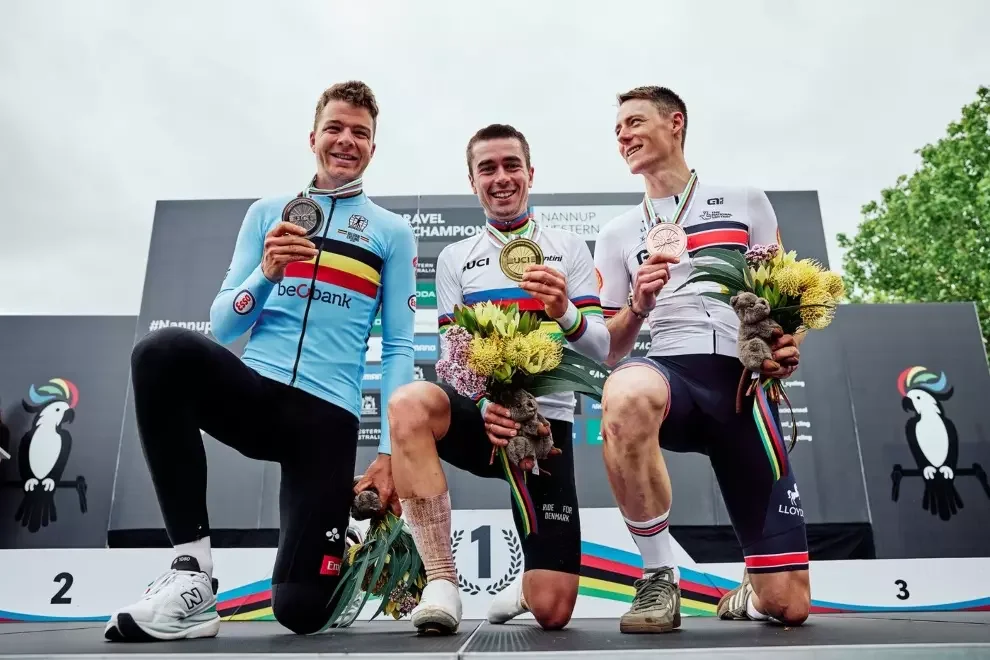
Magnus Bak Klaris arrived at the finish in Nannup expecting a chance at the podium. He left with the elite men’s Gravel World Championship title, earned in a four-rider sprint after 144 kilometres and four hours, nine minutes and five seconds of racing. His own post-race description of his sprinting ability made the result even more striking: “I usually don’t have a really good sprint.”
The Danish rider beat defending champion Florian Vermeersch and Britain’s Connor Swift, while fellow Dane Mads Würtz Schmidt finished fourth. All four received the same finishing time. The result gives the championship a winner characterised as a gravel specialist, following editions won by road professionals.
A long chase shaped the race
The decisive group formed after early escapees Lukas Pöstlberger, Jenson Young and Peter Schulting gained an advantage approaching three minutes. That gap left the riders behind with a substantial pursuit to manage. Danish riders contributed heavily to bringing the race back together, and the contest eventually narrowed to Bak Klaris, Würtz Schmidt, Vermeersch and Swift.
Bak Klaris said his initial goal was a podium. Reaching the front group made that ambition feel realistic; the sprint then turned a medal prospect into a world title. His win followed another strong result at the Halmstad qualifier, which he won two weeks earlier. That performance had already offered a clear sign that he could contend at the front.
The four-rider finish had an apparent tactical feature: Denmark had two riders against one Belgian and one Briton. But a shared nationality didn’t mean Bak Klaris and Würtz Schmidt were racing under a formal team plan. “I paid my own trip,” Bak Klaris said, explaining that the two had agreed to chase their own results and help each other when it made sense.
That arrangement mattered when Würtz Schmidt slid out on a late corner. Bak Klaris reduced his effort, giving his compatriot a chance to get back into the group while making the other riders contribute to the pace. The move served both a personal and a shared interest: it conserved energy and kept Würtz Schmidt in contention. The episode also showed how, in a small group late in a gravel race, a brief incident can quickly change who has to work.
Swift’s move set up the sprint
Bak Klaris called the closing phase “hectic.” After Würtz Schmidt’s slide and the regrouping, Swift accelerated late. Bak Klaris followed, and Swift ended up leading the riders toward the finish with the Dane positioned behind him. That wheel gave Bak Klaris a chance to save energy before making his final effort.
He described the decisive surge as a “small last kick.” It was enough to come past Swift and take the rainbow jersey. His modest assessment of his sprint may have been accurate before this race, but the finish in Nannup gives rivals a new result to account for. A sprint win from a four-rider group depends on positioning, timing and the ability to respond after a long day; Bak Klaris had all three when it mattered.
His reaction was less polished than the finish. “I can’t believe it right now,” he said after the race. Asked what becoming world champion would mean, he answered, “I have no idea,” adding, “I’ve never tried it before.” It’s an honest response to a title he had not set out expecting to win.
A result with more than one route to the front
The race’s defining details were not just the final sprint. The early escape forced a long chase; Denmark’s work helped close the gap; and a late corner incident briefly reshaped the front group. Bak Klaris then used Swift’s acceleration and position to reach the finish with enough energy to get past him. Those developments made the final four-rider contest a test of patience as much as speed.
For gravel riders watching the result, Bak Klaris’s path offers a useful reminder about how a race can turn. A rider who has been working toward a podium can find a winning opportunity through the group’s changing demands, not a single perfectly controlled move. Here, the Dane’s own ambitions, his decision to ease off after Würtz Schmidt’s slide and his choice to follow Swift all contributed to the outcome.
Bak Klaris’s victory also shifts attention toward the growing presence of gravel specialists at the top of the championship. His Halmstad win suggested strong form, and Nannup confirmed he could convert that form against a late group containing the defending champion. The title is secured; what comes next is how he adapts to racing with a world champion’s jersey and the expectations that follow it.
For now, the clearest takeaway is simple: Bak Klaris didn’t need to think of himself as a sprinter to win this sprint. In Nannup, he read the final group well, stayed in contact after Swift’s acceleration and found the effort that counted.
Post shared by James Raison (@_jamesraison)
The original report appeared at Škoda We Love Cycling, which covers cycling at welovecycling.com.
===