St. Francis 460 Sea Trial: A Shorthanded Catamaran Built for Offshore Miles
The 45-foot, 10-inch St. Francis 460 paired a steady ride in Palm Beach chop with a protected helm and systems designed for self-sufficient cruising.
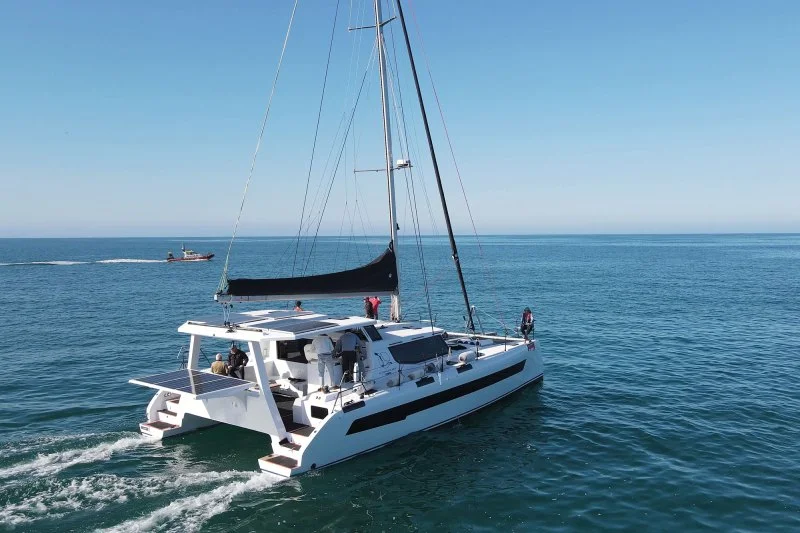
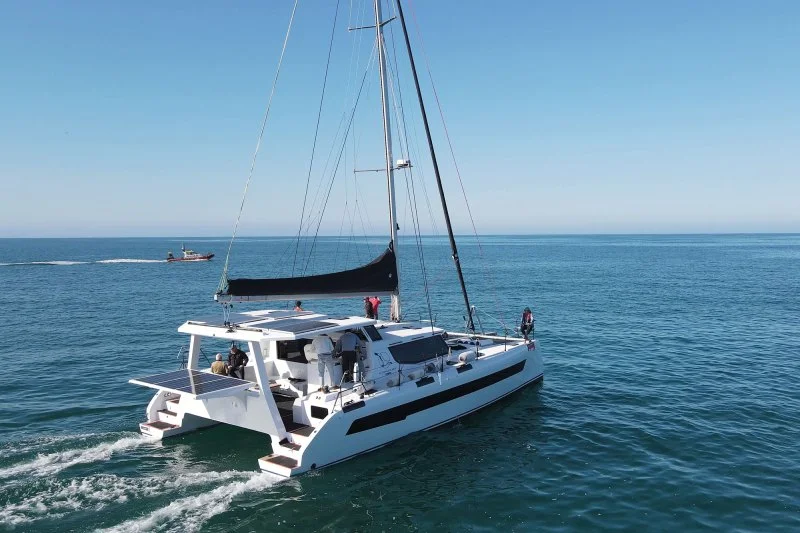
The St. Francis 460’s strongest case is how its offshore features work together: a hull built to stay stiff and light, a helm protected from the weather, and systems designed around managing the boat with a small crew. On a shifty, post-frontal sea trial off West Palm Beach, Florida, it also showed a composed ride through short, steep chop.
A structure shaped for offshore use
The test came two days after a weak cold front passed through. Wind shifted from north to northeast, generally between 10 and 15 knots, with lulls that nearly erased it. Those conditions gave the 460 both light-air sailing and leftover seas to contend with. Under a full main and genoa, it cut through the chop without the hard slamming that can make a cruising day tiring. The ride felt notably settled for a 45-foot catamaran.
St. Francis Marine has built catamarans in St. Francis Bay, South Africa, since 1988. Founder Duncan Lethbridge first commissioned naval architect Angelo Lavranos to design a cruising catamaran for his family. The resulting St. Francis 43 drew enough demand to support a small factory, which has continued its deliberate pace of about four boats a year.
The 460, named Kokoro, debuted at the 2026 Miami International Boat Show. Lavranos and Anton du Toit of Du Toit Yacht Design developed it with input from brokers and customers. Its closest relation is the SF50, which won Best Cruising Catamaran in Cruising World’s 2006 Boat of the Year contest. The 460 carries forward that design’s protected helm, systems suited to a small crew and offshore focus in a 45-foot, 10-inch boat.
Its construction is central to that focus. The hull uses vinylester resin-infused foam-core sandwich construction, with carbon fiber reinforcement at high-load points. St. Francis says the infusion process cut nearly 1,800 pounds compared with its earlier vacuum-bagged system. The yard also describes the resulting structure as stiffer and resistant to delamination. Carbon-reinforced bulkheads are glassed directly into the hull and deck, while generous bridge-deck clearance helps keep the hulls moving through waves.
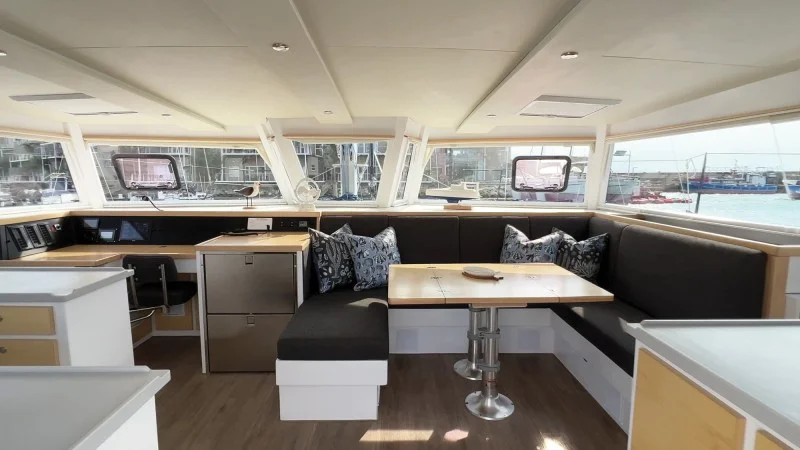
Details inside follow the same practical logic. Compound-curve galley countertops help keep items in place as the boat moves, and the overall fit and finish felt carefully executed. They’re small choices, but at sea, keeping a hot drink or kitchen gear from sliding around matters more than a showroom impression.
Systems for a small crew
Kokoro’s original owner, Michael Farnitano, worked closely with the yard on redundancy, energy independence and the ability to cruise without relying on marina services. Ren Guindon, St. Francis’ sales representative, summed up the design aim: “Everything we do at St. Francis is to singlehand.” The deck arrangement, enclosed helm and sail plan reflect the same question: can one person handle the boat offshore, including at night and in poor weather?
The most visible expression is the hybrid propulsion system, integrated with UK-based Hybrid Marine. It includes a 43.2 kWh lithium battery bank made up of six 48-volt magnesium-lithium units, with separate 24- and 12-volt lithium banks and AGM start batteries. Twin upgraded 57 hp Yanmar diesels are paired with electric drives on each shaft.
At 2,300 rpm, the boat logged 9.4 knots over ground. Under electric power alone, it can run at 4 to 6 knots for up to four hours, according to the review. That range can help with entering an anchorage, maneuvering in a marina or leaving a harbor quietly. Hydrogeneration under sail replenishes the batteries on passage.
Buyers who don’t need the hybrid setup can choose the standard twin 45 hp Yanmars. Kokoro’s configuration reflects Farnitano’s preference for a liveaboard boat with more ways to produce and store energy. It carries no propane; the galley and other onboard needs run on electricity.
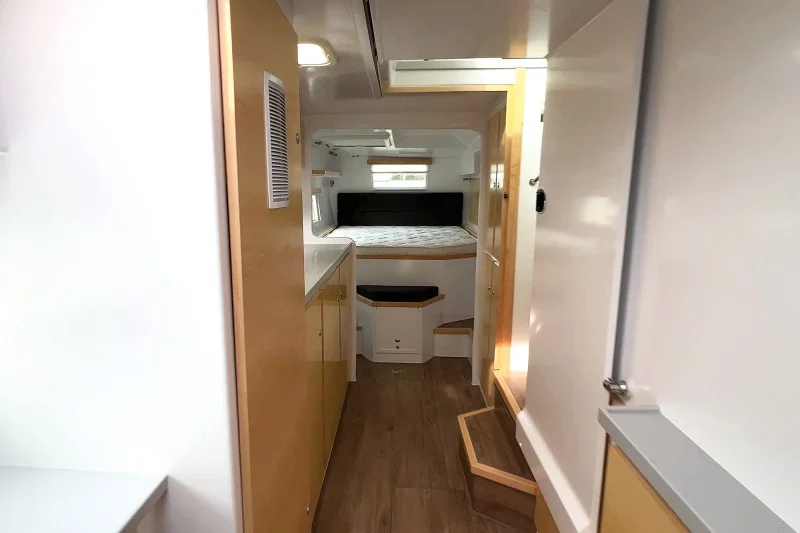
Belowdecks, buyers can choose three- or four-stateroom layouts around a bright saloon. Oversized windows open views across the water. The galley has a Kenyon induction stove, LG oven and Bosch refrigeration. A sliding door links the saloon and cockpit, joining them into a covered living area that can work well at anchor or underway in trade-wind conditions. At the helm, the enclosed station offers all-around visibility and shelter for the watch.
Measured performance in unsettled air
On a reach with the code zero drawing, Kokoro made 7.5 knots in 8.5 knots of apparent wind. Upwind, it pinched to 43 degrees apparent in 13 knots true and held 5.1 knots. That’s a measured result in light, shifting conditions, rather than a promise of performance across every sea state. Guindon said the boat can hold 30 to 35 degrees apparent wind angle in steadier breeze.
Under power, the 460 made 7.5 knots at 2,400 rpm, with the main up and a 3-knot current against it. Tacking with a small crew was straightforward during the trial. The sail plan and deck layout accommodated two people while remaining manageable for a solo sailor, and the enclosed helm kept the operator sheltered and able to see around the boat.
A substantial commitment
The new caretaker aboard Kokoro had previously owned three Fountaine Pajot boats and had followed St. Francis for years. After seeing the 460 at Annapolis, he chose it for its waterline and scope for personalization. He’d only recently taken delivery, with a Bahamas passage and Gulf Stream crossing included in the handover, but already seemed comfortable aboard. “Solid” and “Well built” were his repeated assessments. He was planning to head up the East Coast to Maine, with the Great Lakes also on his list.
At roughly $1.3 million base and $1.6 million fully equipped, the 460 is a considerable purchase. The sea trial suggests its appeal lies in the combination of offshore construction, protected working space and self-sufficient systems, backed by steady behavior in the conditions tested. For anyone considering extended cruising, its design choices are best judged against crew size, desired range and the systems they’ll want to manage underway.
The post Built for Blue Water: St. Francis 460 Boat Review appeared first on Cruising World.