Tour de France Femmes 2027: British Start, London Team Time Trial and Puy de Dôme Finish
Nine stages from Leeds to Puy de Dôme bring a London team time trial, varied racing in France and a demanding final climb.
A route built to keep the race open
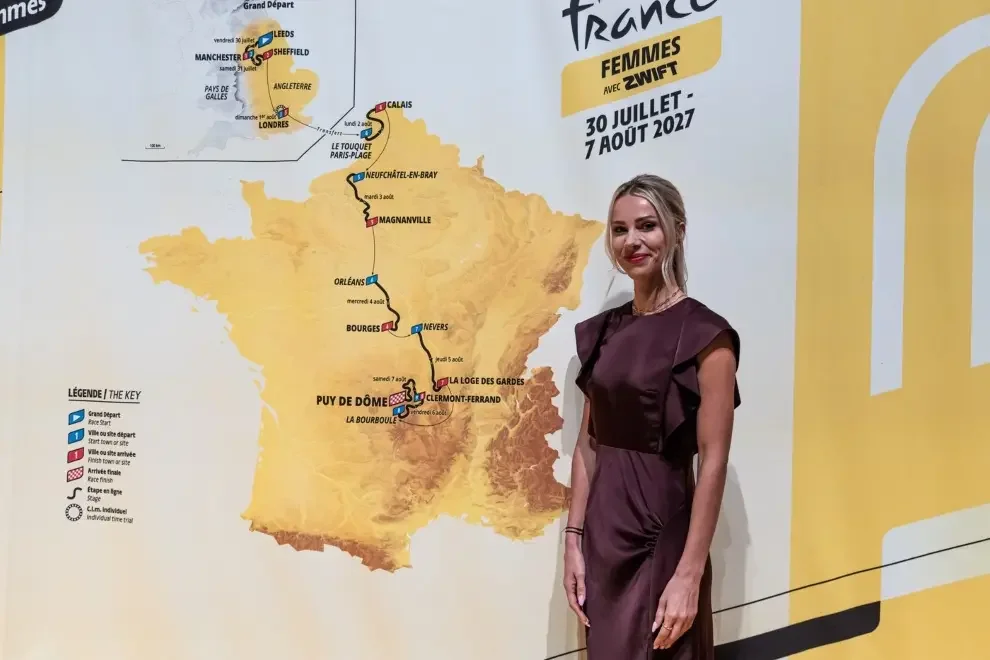
The 2027 Tour de France Femmes avec Zwift puts its hardest test on the final day. Riders will cover 1,156 kilometres and about 17,665 metres of climbing across nine stages, with the overall contest set to reach its verdict on Puy de Dôme. Before that, the route travels from Leeds through London and northern France, mixing climbs, exposed roads, sprint chances and a first team time trial for the modern race.
The sixth edition runs from July 30 to August 7. Its shape asks for more than a specialist’s strength: contenders will need to manage a short, hilly opening, a group effort against the clock, and three demanding days in the Massif Central. With the final climb saved for the last stage, a lead built earlier may not be enough to settle the result.
Yorkshire opens with two testing stages
Great Britain hosts the race’s first three stages. Stage 1 leaves Leeds for Manchester on July 30, covering approximately 86 kilometres. The distance gives sprinters a plausible opportunity, but the route crosses the Pennines over several categorised climbs. That terrain could make the opening yellow jersey a contest of timing and positioning as well as speed.
Stage 2 is a tougher proposition: 154 kilometres from Manchester to Sheffield, with nearly 3,000 metres of climbing. Seven categorised ascents cross the Peak District, including Winnats Pass and Snake Pass. Short, steep efforts near Sheffield could expose differences between general classification contenders early in the week, while leaving room for attacks from riders who thrive on punchy terrain.
The start also connects the event to Yorkshire’s cycling history. Leeds hosted the men’s Tour de France Grand Départ in 2014, and the county has ties to British champions Beryl Burton and Lizzie Deignan. The women’s race begins in a place with a deep connection to the sport, then heads south for a different kind of test.
London adds a team race against the clock
On August 1, Stage 3 brings the first team time trial in the modern Tour de France Femmes. Teams will cover 18 kilometres through central London, finishing on The Mall. The short course still gives collective performance a direct role in the general classification before the riders reach France.
A team time trial depends on riders sharing the work and holding a fast, coordinated pace. Teams must balance the strength of their climbing leaders with the ability of the whole group to sustain speed. A few seconds gained here could matter once the route turns uphill, making preparation and team selection especially relevant for riders with overall ambitions.
The London setting also gives women’s professional cycling a prominent stage in a well-known sporting city. For viewers, the format offers a clear change of rhythm: after two road stages shaped by terrain and attacks, the teams will race as coordinated units.
Three French stages reward different strengths
After the British opening, Stage 4 runs 123 kilometres from Le Touquet-Paris-Plage to Calais, along roads near the Channel coast. Wind across exposed roads could make group position important. The rolling finish leaves options for sprinters and attackers, so the outcome may depend on how the peloton handles the terrain before the final kilometres.
The 161-kilometre Stage 5 from Neufchâtel-en-Bray to Magnanville has a demanding finale that may suit powerful Classics specialists. Stage 6, from Orléans to Bourges, looks like one of the clearest chances for a conventional bunch sprint. Yet these stages may not offer easy passage for the overall contenders: crosswinds, positioning and repeated pace changes can shape the race even when a stage does not finish on a major climb.
The route offers relatively few straightforward sprint opportunities, which makes each suitable finish valuable for the fastest riders. For the general classification, the challenge will be to stay alert through varied racing before the decisive block in the Massif Central.
The Massif Central brings a three-day test
Stage 7 finishes atop La Loge des Gardes, where the final climb measures 6.7 kilometres at an average gradient of 7.1%. It is the race’s first mountain-top finish and an early chance for climbers to measure one another.
Stage 8 covers 151 kilometres from La Bourboule to Clermont-Ferrand, with six categorised climbs and approximately 3,000 metres of elevation gain. It doesn’t end at altitude, but the succession of ascents and technical terrain could invite aggressive racing. Riders will also have the final stage in mind: conserving energy may be difficult if the race is already moving quickly.
The last day runs 170 kilometres from Clermont-Ferrand to Puy de Dôme, making it the longest stage. About 3,800 metres of climbing and eight categorised ascents lead to the final 11.3-kilometre climb, which averages 7.8%. The mountain has a notable place in Tour history. Jacques Anquetil and Raymond Poulidor battled there in 1964; after a 35-year absence, it returned to the men’s race in 2023, when Michael Woods won the stage. In 2027, the women’s peloton will climb it in this race for the first time.
Finishing with the toughest stage keeps the overall contest alive late. The winner could remain uncertain until the closing kilometres on the summit.
Climbing strength meets team depth
Defending champion Demi Vollering, who won her second Tour de France Femmes title in 2026, is among the likely contenders. Her climbing ability and versatility appear well suited to a route that moves between steep efforts, varied road stages and a demanding finale.
Kasia Niewiadoma-Phinney, the 2024 champion, may find room for her aggressive style on the shorter climbs and transitional stages. Her reflections on winning the 2024 race offer a reminder of how decisive bold riding can be. Pauline Ferrand-Prévot, winner in 2025, brings climbing strength and experience to a finish on home soil. Marlen Reusser and Elisa Longo Borghini are other established riders who could shape the contest, while younger riders may add uncertainty.
The team time trial complicates the usual balance between individual form and collective support. Teams will need to help their leaders in the mountains while also assembling a group capable of performing over 18 kilometres against the clock. Across nine stages, versatility and timing look likely to matter as much as outright climbing strength.
From Leeds to the Puy de Dôme, the route offers several distinct tests, then reserves its biggest one for last. That design gives riders multiple ways to shape the race and leaves the final climb as the clearest measure of who can still take time when it matters most. See the Tour de France Femmes route information.