Jeanneau Sun Odyssey 455: A Spacious Cruiser That Sails at Nine Knots
A rainy Newport sail revealed the 455’s roomy interior, practical storage and easy handling, with a nine-knot reach under main and genoa.
On a wet summer day in Newport, the new Jeanneau Sun Odyssey 455 made a persuasive case for judging a cruising sailboat by the whole experience: a roomy cabin, straightforward systems and a relaxed ride under sail. The breeze sat at 12–15 knots, and the boat reached nine knots with little effort. Rain followed us out of the marina, but the crew stayed cheerful—and the boat felt built for days when comfort matters as much as speed.
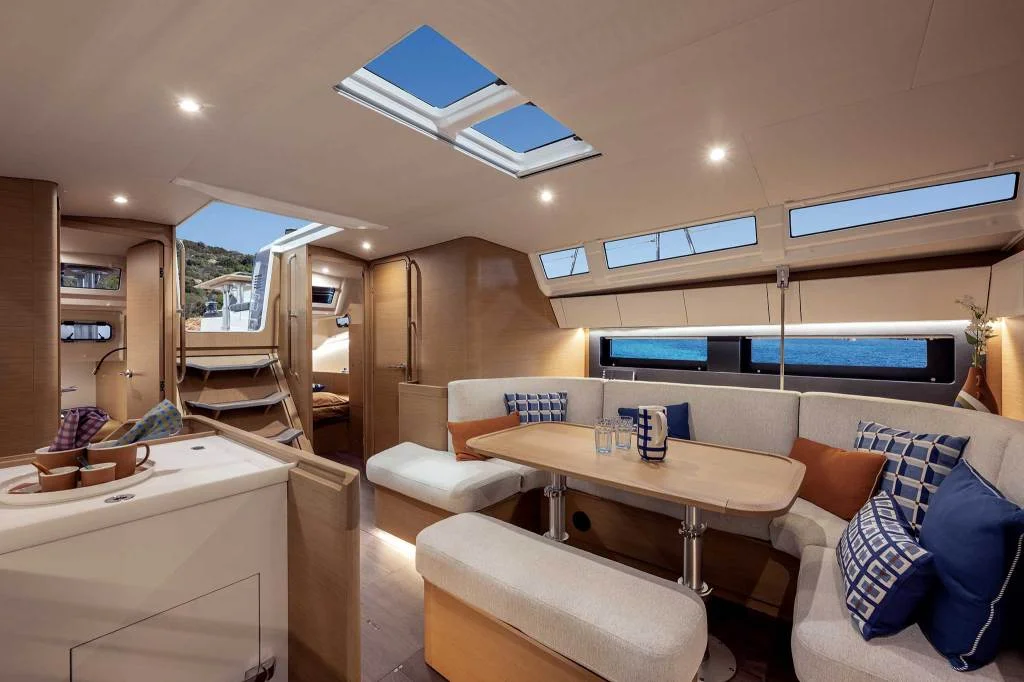
The boat was hull #6, the first 455 to arrive in the United States, and had just been launched. Its hull and deck are entirely new designs. At 48 feet 5 inches overall, with a 14-foot 8-inch beam, it carries a notably generous interior. The fuller hull shape carries more width lower down and farther forward, giving the three-cabin, two-head version a sense of space that compares favorably with larger boats.
A cabin designed for time aboard
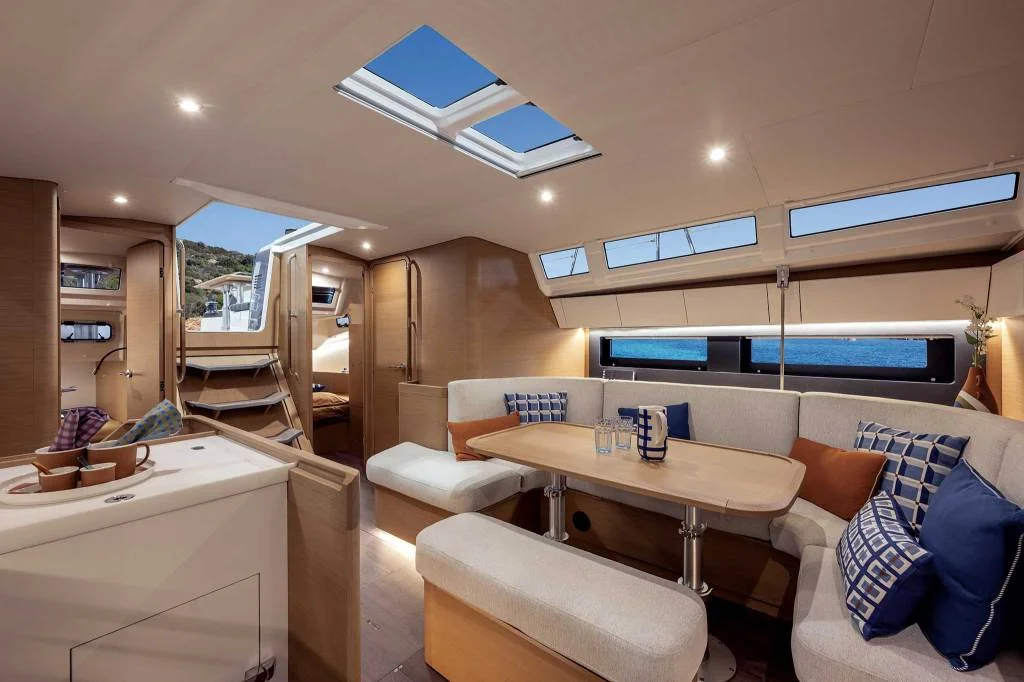
We took shelter below as the rain strengthened. The salon makes effective use of the available volume: its dinette converts into a double berth, and the optional dual-table arrangement lets owners lower one table while keeping the other in place. Storage sits under the settees and movable bench. Opposite, the U-shaped nav station seat can become a chaise, with a drop-down headrest and footrest stored nearby. It’s an inviting place to settle in, and it adds another comfortable spot for casual company.
The galley stays bright despite its deep upper cabinets, set between hull and cabin-top windows. Its C-shaped counter places the fridge opposite the sink, with a two-burner gas cooktop and oven outboard. That layout keeps the work surfaces usable while making the main appliances easy to reach. A side-loading door in the fridge helps retrieve items at the bottom without clearing everything from above.
Dedicated drawers for spices and cutlery keep supplies organized and limit clatter underway. A slim drawer on the sink face holds sponges and brushes. Lighting beneath the galley joinery and elsewhere along the cabin brightens the sole, while a built-in dustpan adds a simple cleanup feature: lift the panel forward of the companionway steps to uncover a removable tray. The opening also provides bilge access.
The owner’s cabin forward includes a tip-out laundry bin, deep drawers, a tall hanging locker, twin ventilation hatches and well-placed power outlets. Its ensuite head has a separate shower stall and natural light. In the three-cabin, two-head arrangement, two additional cabins sit aft, one on either side of the companionway. The port head also has a separate shower; a ventilated room to starboard can serve as a workshop, pantry, hanging locker or laundry space.
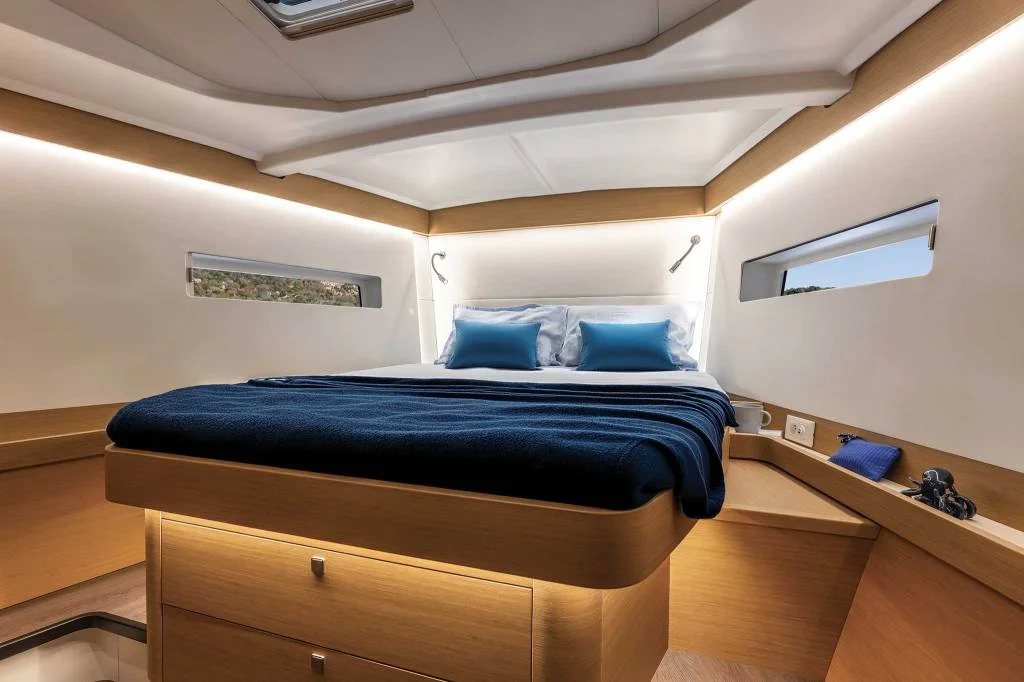
Charter layouts make a different use of the forward volume: the four-cabin, four-head and five-cabin, three-head versions divide the owner’s cabin between two cabins, each with its own ensuite head. Across the layouts, the 455 offers several ways to balance sleeping capacity, storage and working space.
The floorboards on the boat we sailed were screwed down. Purpose-placed access panels provide access to key systems, while the fixed boards helped keep the cabin quiet underfoot during our time aboard. Handholds are thoughtfully distributed, from countertop fiddles to leather-wrapped stainless-steel bars. A passage in more demanding conditions would be the real test of their coverage, particularly in the heads, but the existing arrangement gives owners a useful starting point for assessing their needs.
Simple sail handling and a steady ride
Underway, an optional 80-horsepower turbo Yanmar Saildrive powered the boat away from the mooring field. Once the sails were set, the headsail and mainsail could be trimmed from Harken winches positioned forward and inboard of the helms. Floating genoa leads reduce deck hardware: one tweaker adjusts the height of the low-friction ring. The mainsheet uses a fixed bridle instead of a traveler, with lines running to either side of the cabintop. The setup permits close sheeting while still allowing the mainsail to twist off.
The 455 sailed cleanly to weather, drawing most of its power from the genoa. Its minimal overlap should make tacks quick. Owners can choose an in-mast-furling mainsail or larger semi-battened and fully-battened options. The in-mast sail measures 496 square feet, compared with 581 square feet for the standard semi-battened sail and 591 square feet for the performance fully-battened sail. The larger sails should offer more area and shape; our outing didn’t include a chance to assess them.
The twin-rudder helms felt neutral and required little effort, even in puffy conditions. That ease could suit long stints at the wheel, though sailors who like strong feedback through the steering may find the feel less informative. Optional Raymarine Axiom+ plotters put sailing data within reach of the helmsman.
On a reach under main and genoa, the boat touched nine knots without much effort. Moving between the helm and bow was also straightforward. The walk-up side decks avoid the need to climb over coamings or thread around deck hardware. A double-spreader aluminum rig places the V1 shrouds outboard and the D1 shrouds inboard of the side deck, leaving a clear route forward and extra places to hold on.
Storage, sail stowage and specifications
A wide foredeck locker provides access for stowing and retrieving light-air sails, including spinnakers in their socks. The anchor locker and windlass sit ahead of it. An integrated bowsprit carries the anchor and can also take an optional Code 0 or asymmetrical spinnaker.
Aft, the cockpit has a life-raft locker behind the companionway, with space farther back for either an optional generator or more storage. Matching lockers sit beneath the cockpit seats. Storage under the helmsman seats is available unless the starboard seat is fitted with the optional cockpit fridge. There’s also a lazarette, where equipment needs to be stowed clear of the steering gear and other systems. Optional arches and davits provide dinghy storage, and a large swim platform eases boarding.
A Sleipner bow thruster helped make the return to the dock smooth. The rain eased to drizzle as we stepped ashore, after a sail across a nearly empty Narragansett Bay. That easy finish captured the 455’s appeal: practical details support a comfortable day on the water, while the sailing remains engaging when the breeze fills in.
Specifications
- LOA: 48’5”
- Beam: 14’8”
- Draft: 7’9” standard; 5’9” shoal
- Ballast: 5,933 lbs
- Displacement: 24,864 lbs light
- Sail area: 1,109 sq ft standard; 1,128 sq ft performance
- Power: 57 HP Yanmar diesel