IRONMAN World Championship 2026: Kona Course, Athletes and Viewing Guide
Kona welcomes 2,548 athletes for a one-day championship, with a demanding swim, windy bike course and heat-exposed run.
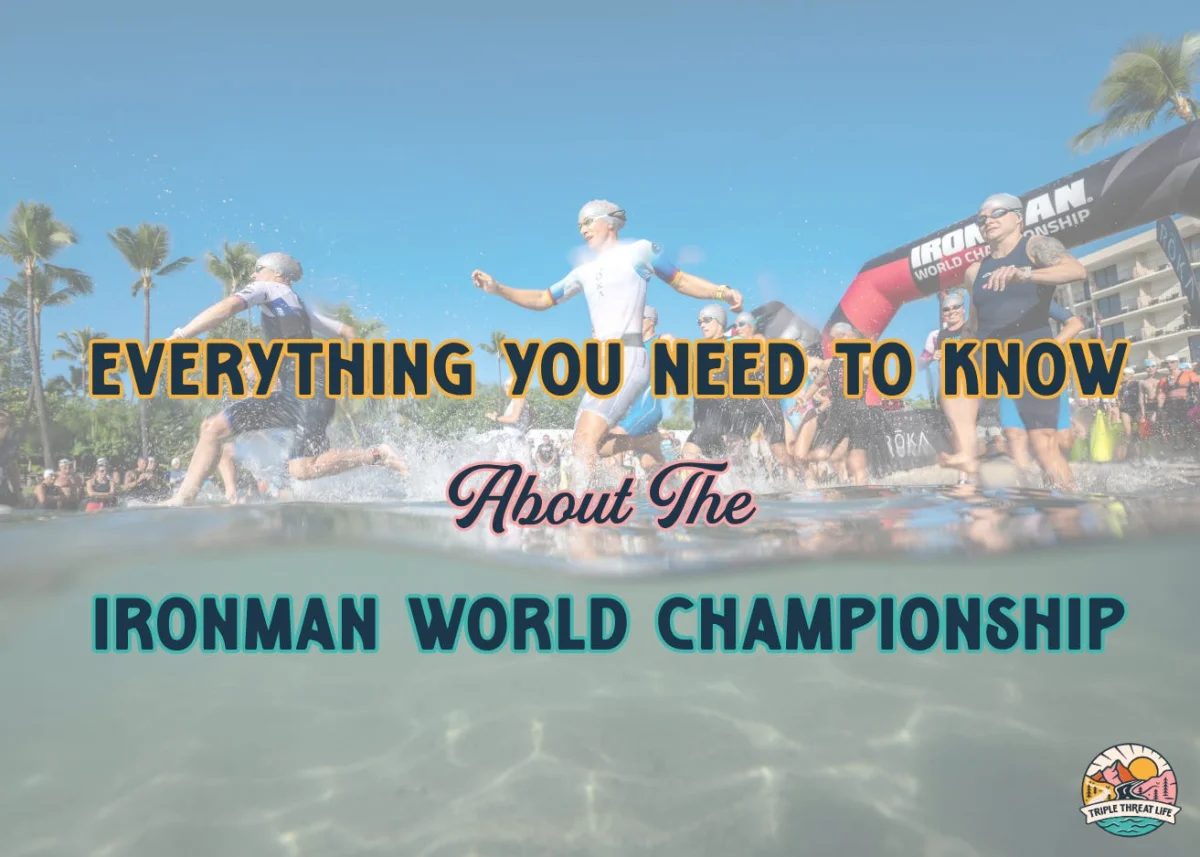
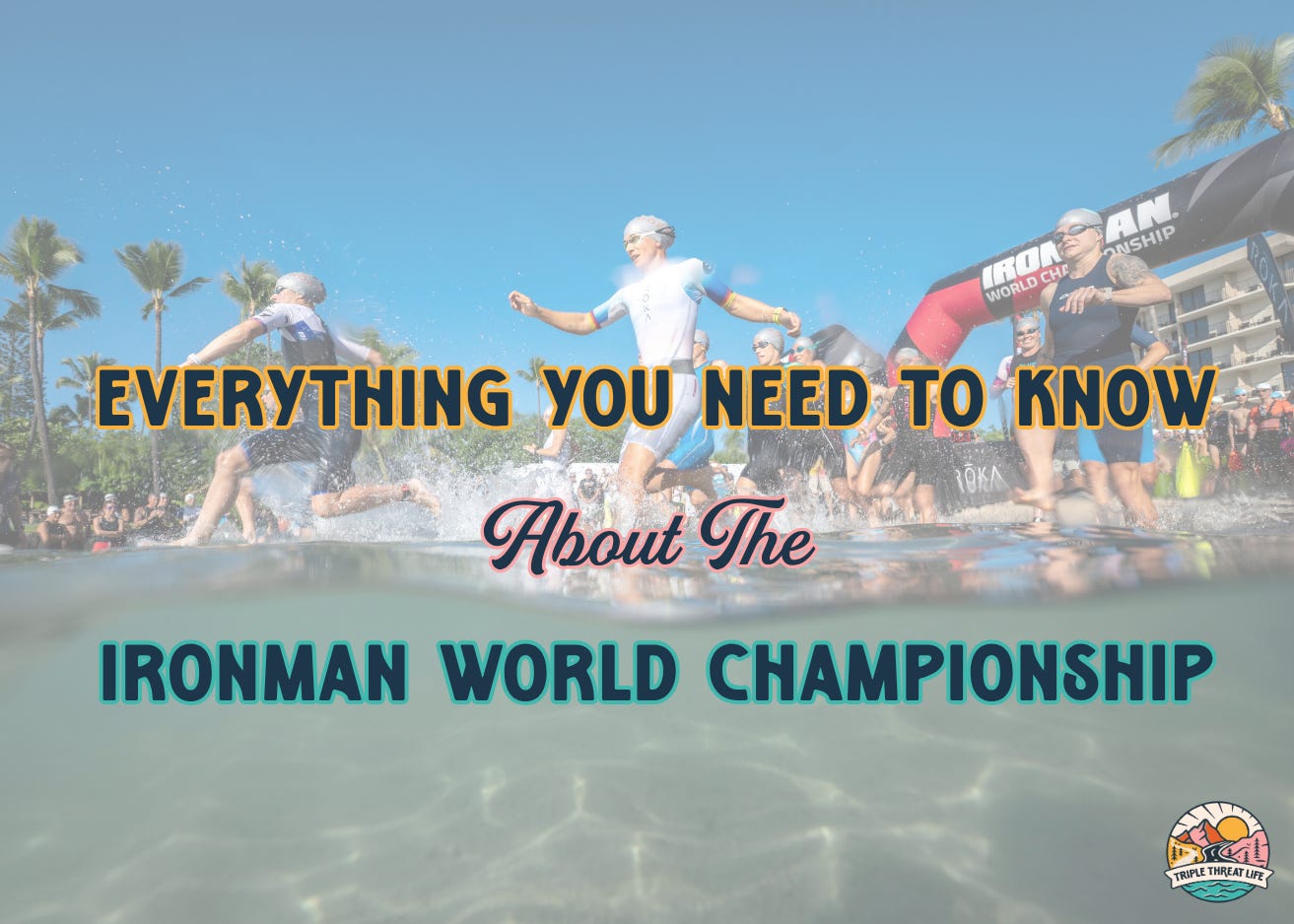
Kona’s return as the setting for a one-day IRONMAN World Championship brings the men’s and women’s professional fields together for the first time since 2019. The 2026 race is scheduled for Saturday, October 10, with 2,548 athletes from 85 countries set to cover the full-distance course. Its scale is striking, but the island’s swim, exposed bike route and hot run are the details that will shape the day.
The championship’s history began elsewhere in Hawaii. The first IRONMAN took place on O’ahu in 1978, before the event became closely associated with Kona. Its creation is often recounted as a contest to settle whether swimmers, cyclists or runners were the best athletes, or as the result of a drunken wager. Judy Collins, co-founder of that first race, told a different story in a 2022 interview with Triathlete Magazine. That origin story matters: the event’s mythology is familiar, while its actual beginnings are less widely understood.
The 2026 field
The entry list spans generations and experience levels. There are 110 professionals—54 women and 56 men—and 2,427 age-group athletes. Women make up 689 competitors, or 27% of the full field: 54 professionals and 635 age-group athletes. Athlete ages range from 18 to 84, with an average age of 46.
The largest men’s age group is 55–59, with 276 athletes. Among women, the 30–34 and 45–49 groups are tied for the largest, with 85 each. The United States, Germany, Australia, France and the United Kingdom are the five most represented countries. Athletes from 49 U.S. states are entered; North Dakota is the only one without a competitor. California leads the state count, followed by Florida, Texas, Colorado and New York.
The youngest woman is 18-year-old Francesca DelPresto of the United States; Germany’s Tyler Smuda, 19, is the youngest man. The oldest woman is 79-year-old Linda Ashmore of the United Kingdom, and the oldest man is 83-year-old Robert Plant of the United States. Eleven returning age-group winners and 300 Legacy Program athletes are also on the start list.
Three distinct tests on the Kona course
Swim: Kailua Bay
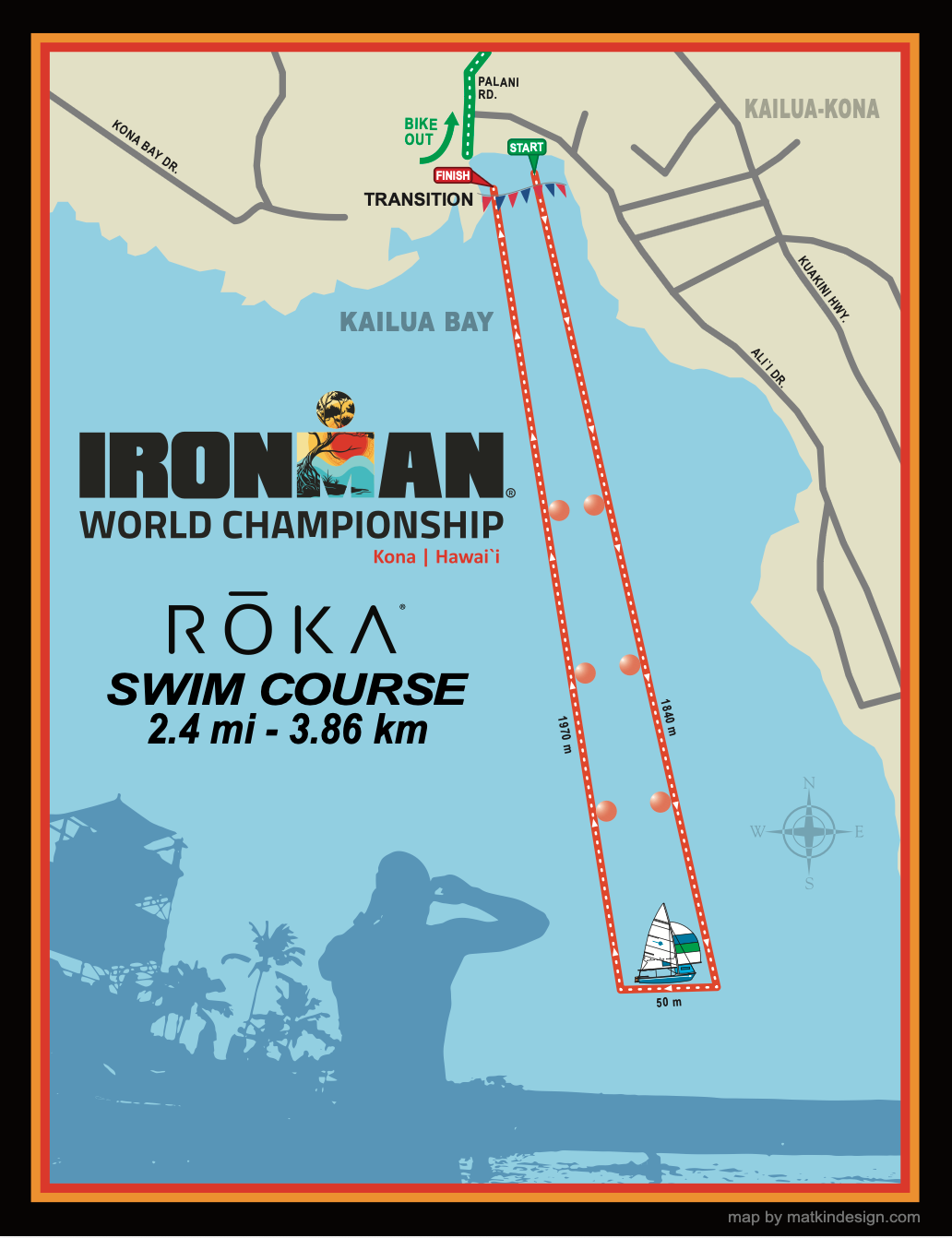
The day starts with a 2.4-mile, clockwise out-and-back swim in Kailua Bay, beneath Mt. Hualālai. Athletes start by age group in the water. The sea is typically warm, and swimmers may encounter turtles and fish; wind can make the surface choppy, so conditions on race morning will matter.
A recent box jellyfish bloom led to a shortened Hoa’ala Training Swim. The Hawai’i Jellyfish Calendar listed October 4–6 as the period with the highest probability of sightings. The bloom was expected to be less of a concern on race day, but ocean swimmers should be aware that a jellyfish encounter remains possible. The training swim was shortened in response.
Bike: lava fields and crosswinds
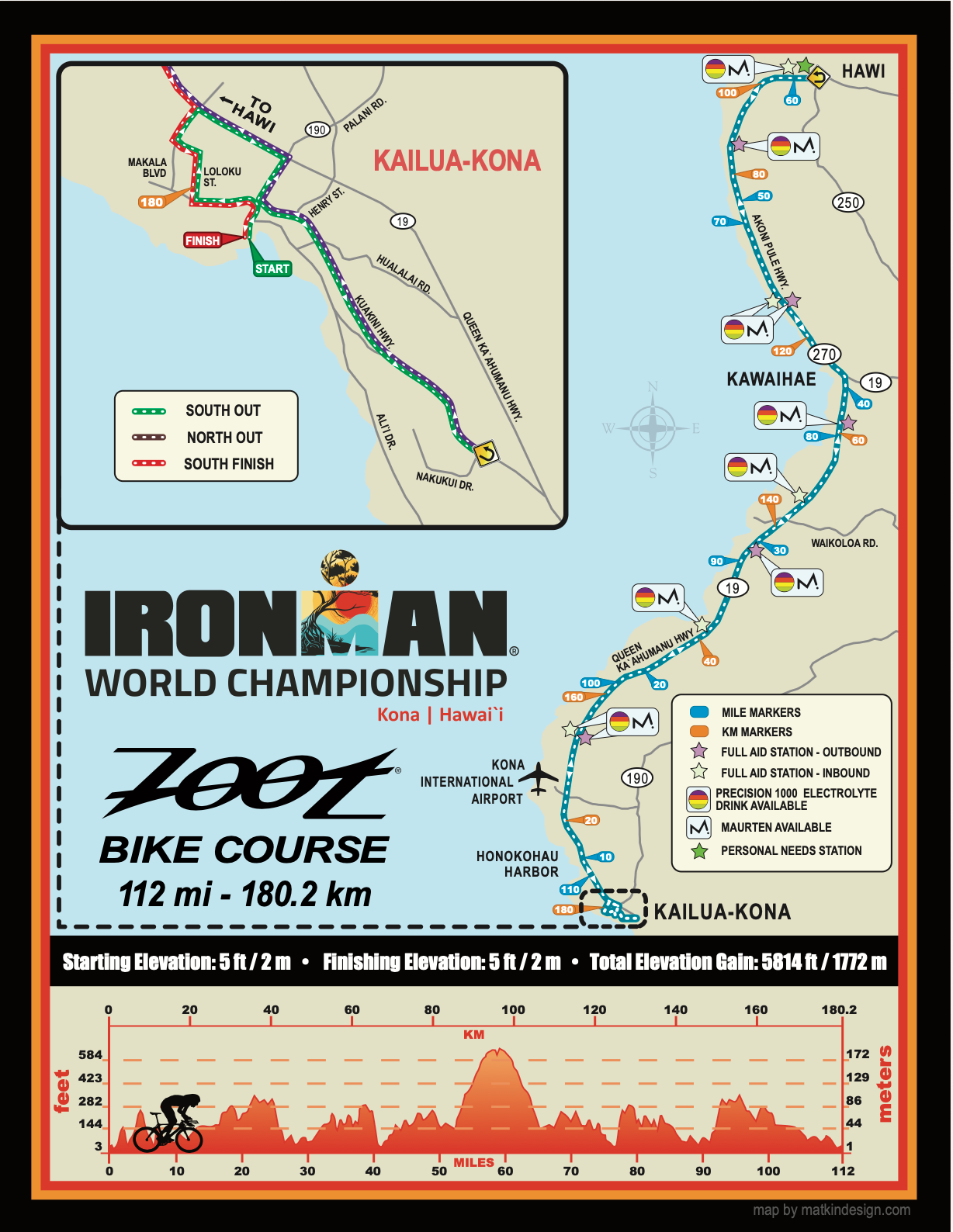
The 112-mile bike leg gains 5,814 feet, carrying athletes from Kailua-Kona to the turnaround in Hawi and back to the Queen Kaʻahumanu Highway. The island setting doesn’t make this a flat ride: climbing, potential strong crosswinds and exposure to the elements combine to make pacing and conditions central concerns.
Riders cross black lava fields beside the tropical coastline, where wind can make the effort unpredictable. The elevation profile adds another demand across a long day in the saddle. The course’s exposed character is a defining part of the Kona challenge.
Run: the Natural Energy Lab
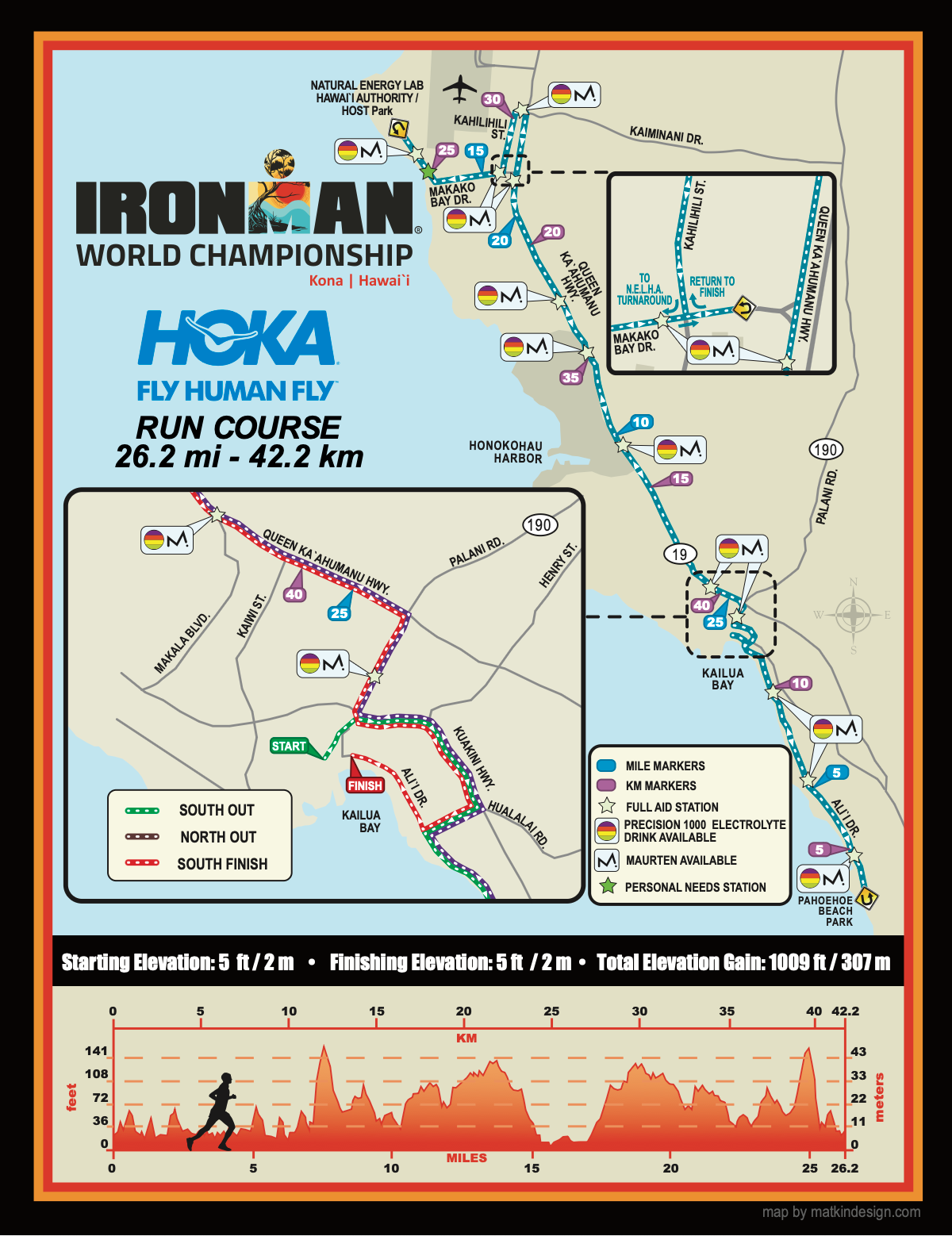
The 26.2-mile run follows an out-and-back route. From town, athletes climb Palani Road to the Queen Kaʻahumanu Highway, then head into the Natural Energy Lab, often called the “hot box.” Heat, humidity and limited shade make this section a major test late in the event. Runners return through Kona for a finish beside Kailua Bay.
Champions, contenders and first-timers
Kona’s women’s championship has had 22 different winners from eight countries. Paula Newby-Fraser holds the record with eight victories, earning her the nickname “Queen of Kona.” Switzerland leads the women’s title count with 11: Daniel Ryf won five and Natascha Badmann six.
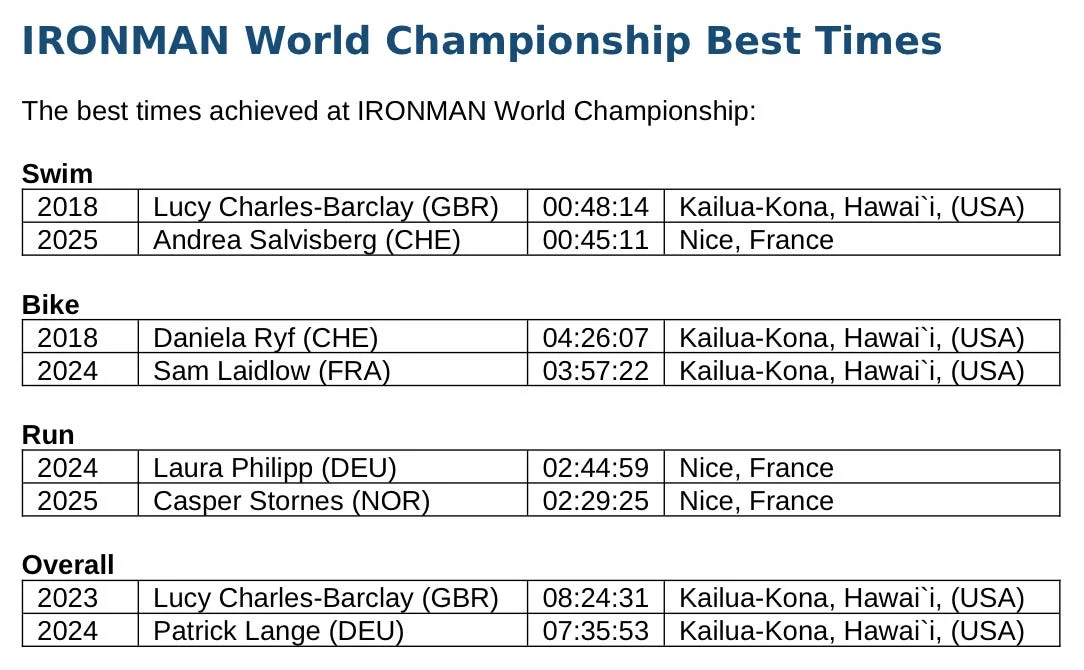
The men’s race has produced 24 winners from seven countries. The United States has the most men’s titles, with 20, including six by Dave Scott. World Championship best times can depend on whether the race was held in Nice or Kona during the event’s rotating-location years. Kona has seen recent marks: the bike record was set in 2024, and overall records were set in 2023 and 2024.
This year’s professional field includes 20 women and 15 men making their World Championship debuts. Recent rookie winners show that first-time starters can contend: Norway’s Solveig Løvseth and Casper Stornes won in 2025, following Chelsea Sodaro and Gustav Iden in 2022, and Chrissie Wellington in 2007.
Canada’s Paula Findlay makes her first Kona appearance after winning IRONMAN Lake Placid, her first IRONMAN. She has 14 IRONMAN 70.3 victories. Switzerland’s Julie Derron, a T100 standout, finished second at the 70.3 World Championship in Nice and won IRONMAN Switzerland. Men’s newcomers include Martin Van Riel, Pierre Le Corre and Vincent Luis.
Japan’s Jumpeir Furuya also makes his Kona debut. He finished third at IRONMAN Western Australia last year and third at IRONMAN Cairns in June. He is the first Japanese professional triathlete to compete at the championship since 2017.
Among returning women, Løvseth arrives as the defending champion after winning on debut last year. Lucy Charles-Barclay, the 2023 champion and a multiple-time podium finisher, returns after taking the 70.3 World Championship in Marbella in 2025. Taylor Knibb finished second behind Charles-Barclay there, then won the 2026 edition in Nice. Kat Matthews has been runner-up at three IRONMAN World Championships, including last year. Laura Philipp, a former champion in Nice, placed third in Kona last year.
Norway’s men’s podium sweep in Nice last year featured Stornes, Gustav Iden and Kristian Blummenfelt. Stornes won in 2025, Iden in 2022 and Blummenfelt in 2021, giving Norway three of the past five men’s titles; an injury means Stornes won’t compete this year. In each of the past two years, athletes from one country won both the men’s and women’s races: Norway in 2025 and Germany in 2024.
Patrick Lange, the 2017, 2018 and 2024 champion, is making his final professional trip to Kona at age 40. Sam Laidlow finished second in Kona in 2022 at 23, then won the championship in Nice in 2023. He has recorded the fastest bike split at the past four World Championships and holds Kona’s current best bike time: 3:57:22, set in 2024. Cameron Wurf, a professional triathlete and cyclist, returns after winning IRONMAN Maryland three weeks ago.
Age-group stories behind the start list
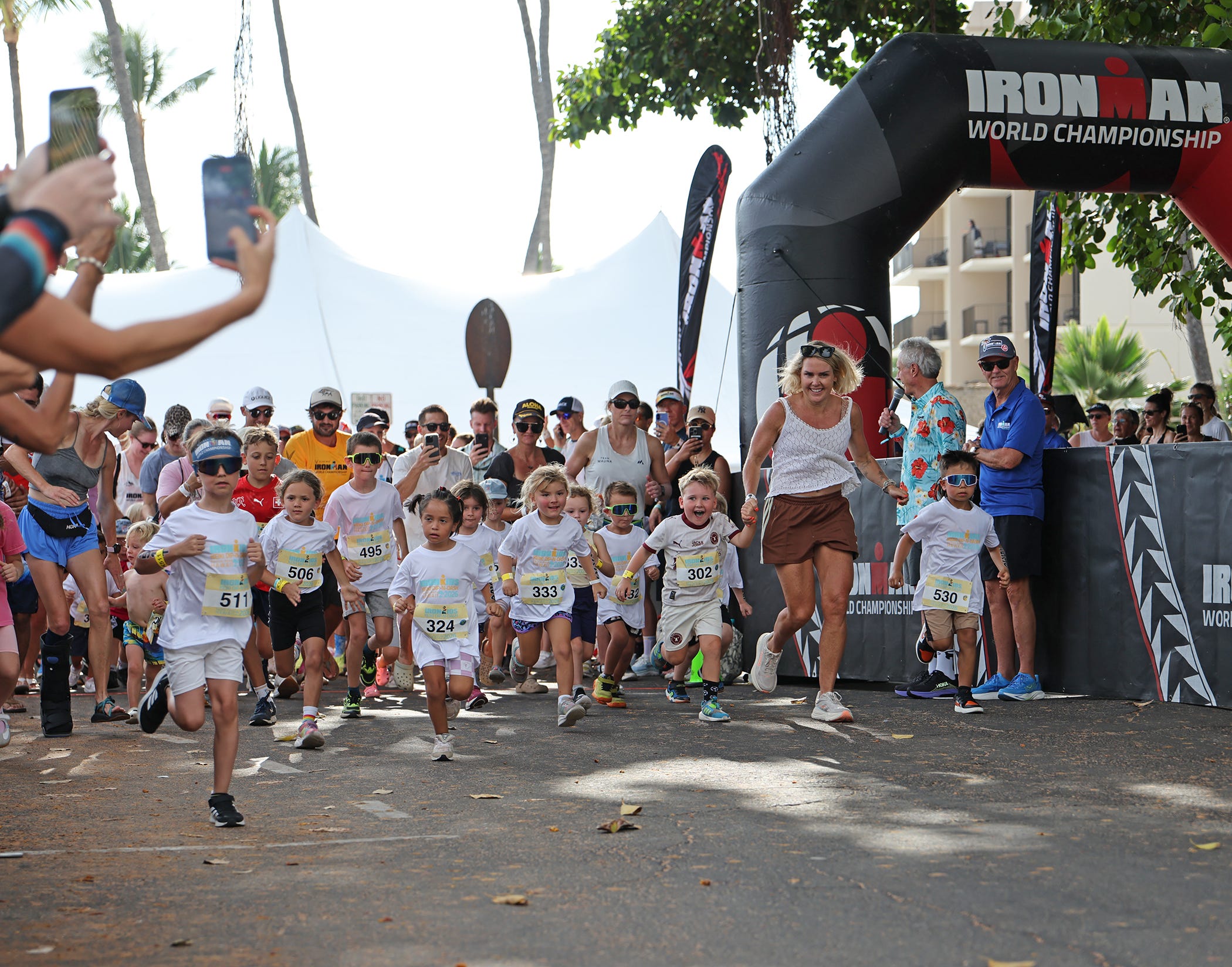
Age-group competitors bring their own histories to Kona. Linda Ashmore, 79, of the United Kingdom is a breast cancer survivor, a grandmother of eight and Britain’s oldest female IRONMAN finisher. She won the 70–74 age group in Kona in 2017, then qualified again in 2026 at 79. She will race in the 80–85 age group, which has had only a handful of women competitors. Ashmore also became the oldest woman to swim the English Channel, at 71.
Robert “Bob” Plant, 84, of the United States began triathlon after volunteering at the 1989 championship. He placed fifth in his age group on his Kona debut and has since earned seven age-group podiums there and 20 USAT national titles. His Kona record for ages 75–79 is 13:06:03. He continues to work full time as a dentist.
Scott Christmas, 57, returned to sport 13 months after surviving a 1996 plane crash that killed his brother, Captain Owen Duke. Christmas was given less than a 3% chance of survival and a 5% chance of recovery. He named his bike “Dukester” in his brother’s honor and wanted to race in Kona, where his brother had been stationed. Two weeks after the championship, he plans to run the Marine Corps Marathon with his daughter and leave both medals at Owen’s grave in Arlington. He also races in memory of his wife, fellow IRONMAN athlete Dr. Amy Christmas, who died of brain cancer in 2017.
Jorge de Amorim, 41, and Matt Davis, 43, return to honor their friend and training partner Sam Jobi. All three qualified for Kona in 2016 and crossed the finish line together, holding hands. Jobi died unexpectedly of a heart attack while running in 2025. A decade after their first trip, De Amorim and Davis will race in his memory.
Amy Dodson, 64, of Tucson lost her left leg to sarcoma at 19 and her left lung two years later. A cancer survivor, she became the first female leg amputee to finish the Boston Marathon and has competed in more than 30 triathlons, including four long-distance events and three IRONMAN races.
South Korea’s Hyungnam Kim, 54, and his daughter Daeun will be the first father-daughter pair from their country to compete in Kona. In another family milestone, Guilherme Vaz, 31, and his father Augusto, 66, are the first father-son pair from Brazil to qualify. At IRONMAN Brazil, Guilherme won the 30–34 age group with a sub-nine-hour finish; Augusto won the 65–69 group.
Jim Logan, 61, of Georgia was diagnosed with stage 4 metastatic colon cancer in 2024 and has undergone chemotherapy, radiation and multiple surgeries. He continues treatment and plans to race for the IRONMAN Foundation with an ostomy, managing the practical demands of the device during the event.
Luca Parmitano, 49, of Texas is an Italian Air Force colonel and test pilot, as well as an astronaut for the European Space Agency. He has completed several IRONMAN races since 2012. Germany’s Normann Stadler, 53, returns to the 50–54 age group more than two decades after winning Kona as a professional in 2004 and 2006. Open-heart surgery ended his professional career in 2011. He has also compared his 2006 and 2026 bike setups in a wind-tunnel feature.
Florida’s Gregory Schaefer, 51, is an 18-time IRONMAN and two-time Kona competitor. Diagnosed with early-onset Parkinson’s disease in March 2023, he returned to the start line in 2024 after a new treatment plan and is aiming for a meaningful finish this year.
Viewing the race
Live coverage begins Saturday, October 10, at 4:30 a.m. HST. The men’s professional start is at 6:20 a.m. and the women’s at 6:30 a.m. The broadcast is available free on YouTube, as well as through DAZN, L’Équipe Live, ESPN Disney+, SuperSport and other platforms.
Commentators include Mirinda Carfrae, Will McCloy, Daniela Ryf, Jan Frodeno, Laura Siddall and Sam Appleton. Expanded coverage is planned to follow the professional men’s and women’s races at the same time, using additional camera and moto units. YouTube Mosaic Multiview will let Smart TV viewers watch up to four live feeds together, including aerial and underwater course footage and the finish line.
On the start line
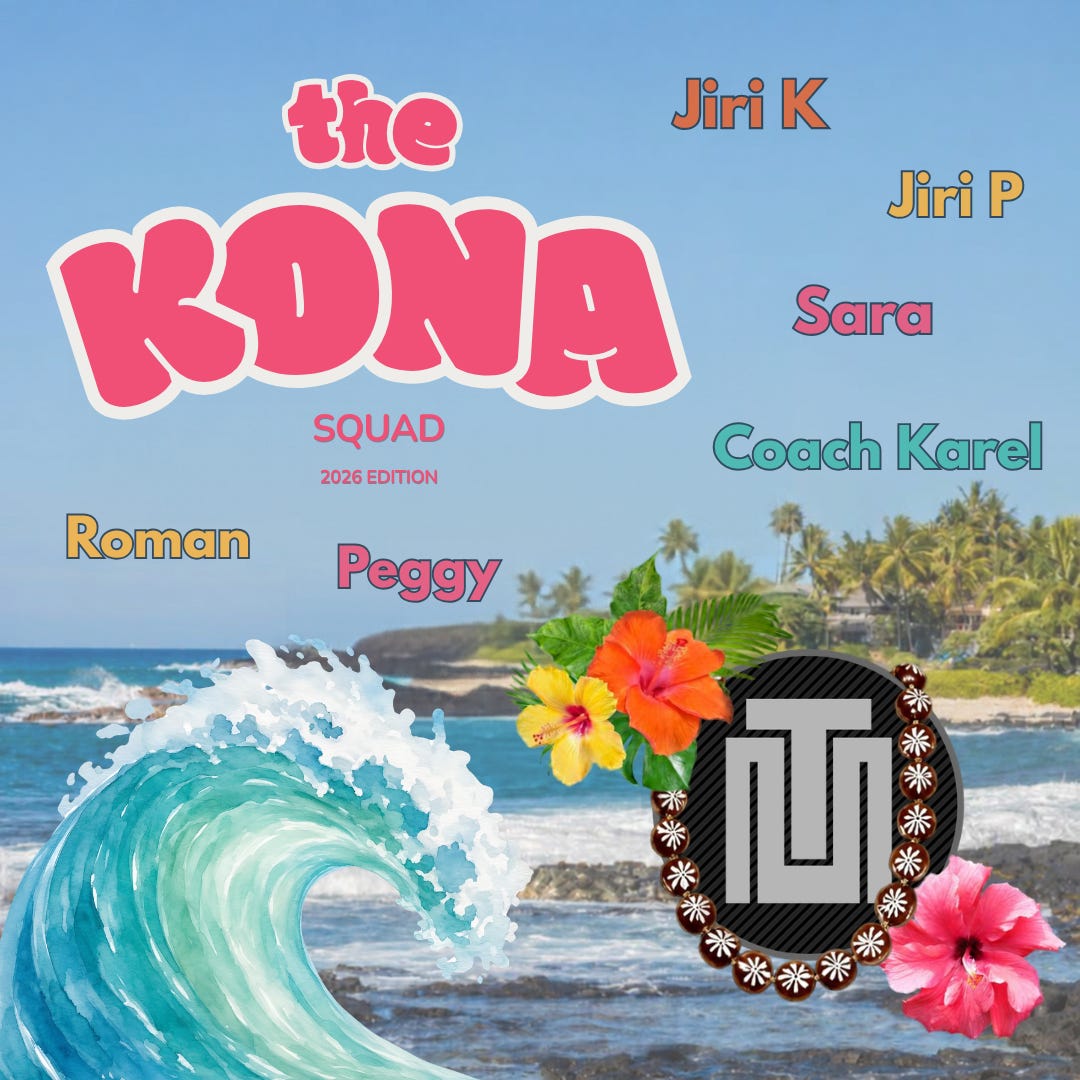
Coach Karel is set for his sixth Kona appearance after winning his age group at IRONMAN Lake Placid. TriMarni teammates Sara Randolph, Peggy Yetman, Jiri Pospisi, Jiri Kaplan and Roman Prochazka are also racing. Their starts are part of a field defined by very different journeys, but every athlete will face the same course: warm water, an exposed ride and a run where heat and shade can set the limits of the day.
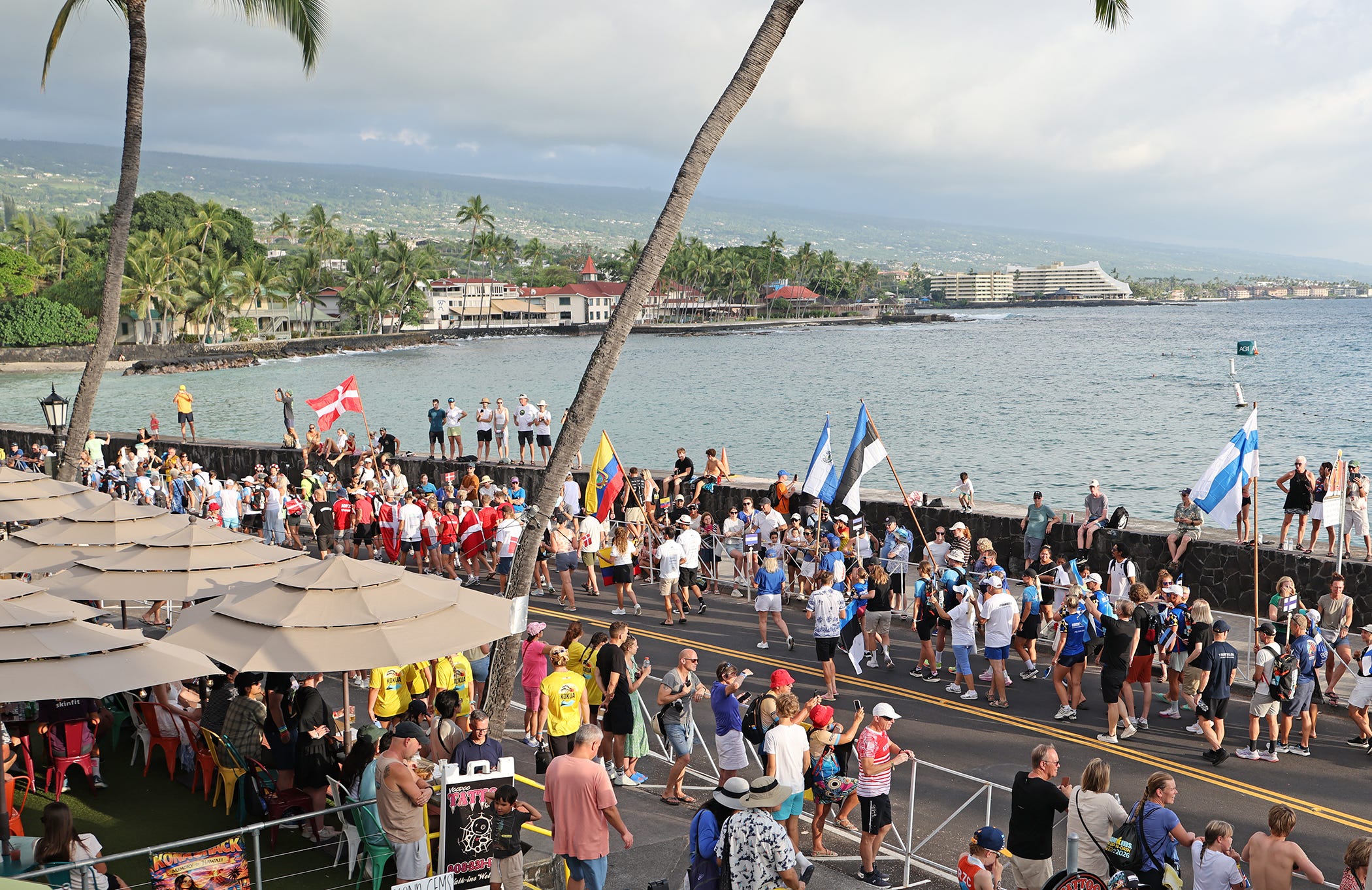
The Parade of Nations offers a glimpse of the people behind those numbers. A short video of the event, courtesy of Zane Wilson for IRONMAN, closes the preview. For athletes and viewers alike, the day’s defining question will be how each competitor adapts as Kona’s conditions unfold.